
Why Everything Arrives at Once
There's a day near the end of a project that clients talk about for years. The house is quiet at breakfast and furnished by dinner. Rugs down, beds made, lamps wired and glowing, art hung and straightened, the kitchen stocked with the things that make a kitchen feel occupied. You walk back in that evening and the house looks like it has always been that way.
That day is the best one, and it's also the most misunderstood. It looks spontaneous. It's actually the last hour of a plan that started a year earlier, when someone chose a sofa fabric while the walls were still open studs.
The furniture gets decided long before it looks urgent
The order of decisions on a well-run project surprises almost everyone the first time. Furnishings aren't the finish line. They're closer to the starting line, because so many of the choices made in the field depend on them.
Where a sofa sits determines where the floor outlets go, and floor outlets get poured into concrete or nailed under subfloor long before anyone shops for a sofa. The scale of a dining fixture determines the blocking in the ceiling. A rug's field color changes what a wall color does at four in the afternoon. Pull the furnishings decisions late and you inherit a house that's already made those calls for you, usually by default.
So the plan gets built in reverse. Ashley works out how the rooms will actually be lived in, then what goes in them, then what the house needs to be built to accept. By the time the drywall arrives, the sofa has been specified, the fabric has been approved, and the order has been placed.
There's a second reason for the early start, and it's simply time. Recovering a piece you already own tends to run six to twelve weeks. Something built from scratch can land anywhere from six to eighteen, and where it falls in that range depends on how complicated the piece is and what fabric you've chosen. Now and then one comes through in four to six and everybody's delighted. Stone gets selected off a specific slab that has to be held and then fabricated. Imported lighting travels by boat. Custom millwork waits its turn in a shop that's serving other projects too. None of that is a problem when it's planned for. All of it becomes one when it isn't.
Why we’d rather deliver a room once
The other half of that install day is what doesn't happen during the months before it.
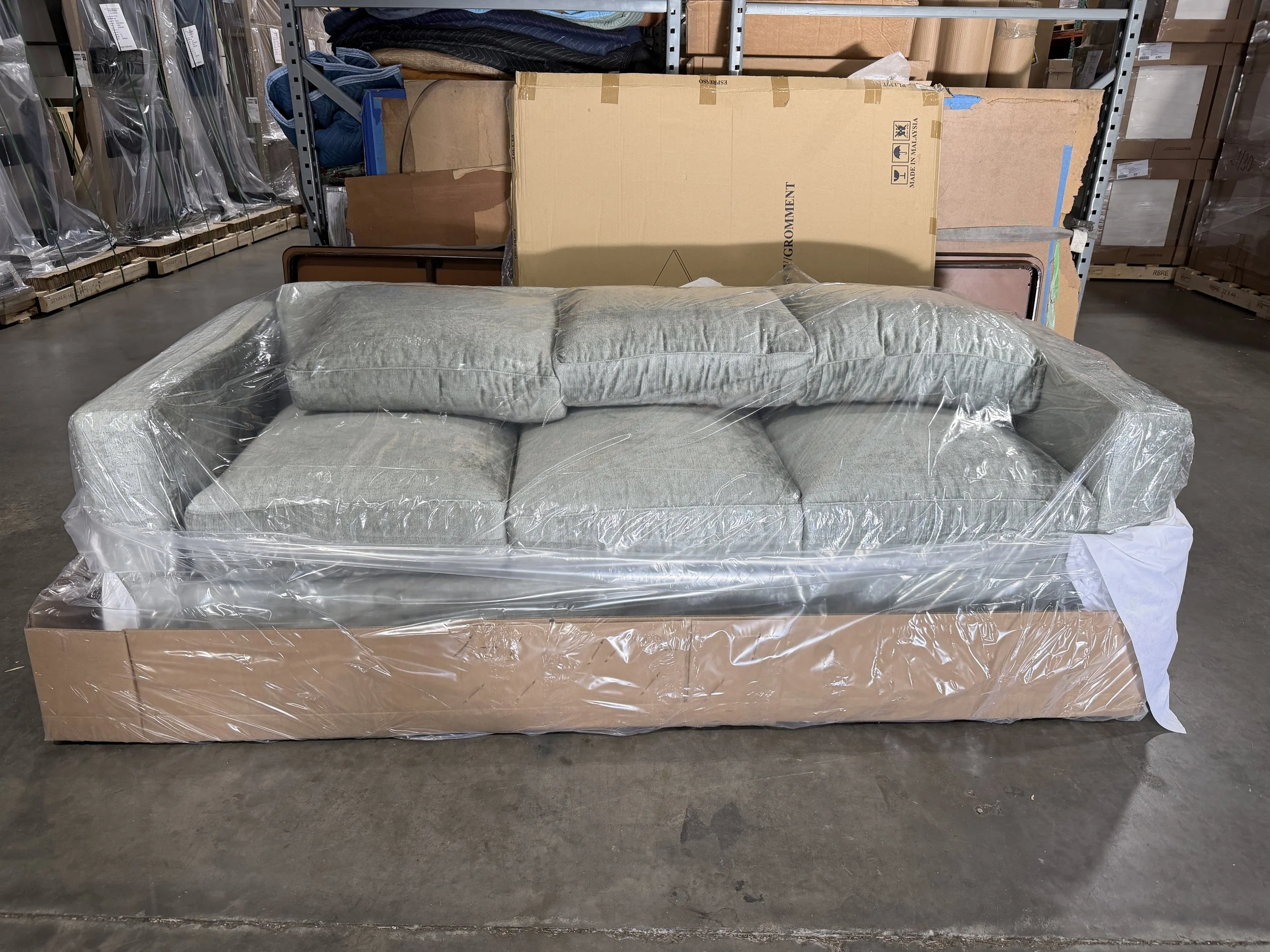
Furnishings for a whole home don't arrive together on their own. They arrive the way they were made, which is to say one truck at a time over the better part of a year. Left alone, that means a delivery window every few weeks, boxes in the dining room, a chair you can't use yet because its companion is still six weeks out, and a house you're living in that never quite settles.
So none of it comes to you. Everything ships to a receiving warehouse, where we personally inspect each piece as it arrives. Every crate gets opened and every item gets looked at, which is the only way to know whether a case good picked up a scuff in transit or a chair came through in the wrong finish.
When something does need attention, and across a whole home something usually does, we handle it from there. The claim gets filed, the replacement gets ordered, the repair gets scheduled, and the timeline gets adjusted while there's still room in the schedule to absorb it. Most of the time our clients never hear about any of it, because by the time they'd have reason to, it's already resolved.
Then the whole home goes in together, in a planned sequence, over a day or a few days depending on the size of the project. Nothing gets unwrapped for the first time in front of you, and nobody is standing in your finished living room discovering a problem.
What that protects is worth more than the logistics suggest. It keeps you out of the freight business for a year. It keeps a beautiful room from being judged half-finished. And it gives you the actual moment, the one where you walk into a completed house instead of watching it accumulate.
What’s happening while you wait
The quiet stretch in the middle of a project is the part clients ask about most, because from the outside it can look like nothing is moving. Quite a lot is.
Orders get acknowledged, and acknowledgments get checked against what was specified, because a fabric direction or a finish code that shifts by one letter is much easier to fix in week two than in week thirty. Ship dates get tracked and re-tracked. Workrooms get called. When a mill discontinues a fabric, which happens, a replacement gets sourced and approved before it becomes a hole in the room.
Meanwhile the construction side keeps its own rhythm, and the two have to stay in step. We work in tandem with your builder so the trades have what they need when they need it, and so nobody is standing in an empty room waiting on a dimension that lives in our drawings. That coordination is most of the job, and when it's done well you barely see it. What you see is a project that keeps moving without needing you to move it.
By the time install day arrives, there's very little left to decide. The decisions were made months ago by people who had time to make them carefully. That's the whole trick, and it's why the day feels effortless when it isn't.
The first evening in a finished home is a specific kind of happiness. You know where the light switches are but the rooms still surprise you. You sit down in a chair that was chosen for that exact spot, in that exact light, for the way you actually spend a Tuesday.
Clients tell us the same thing whether the house is in Atlanta proper, in Buckhead or Sandy Springs, or out in East Cobb. The house feels like it's been waiting for them. It has been. Everything in it was decided a long time ago, by people paying close attention, so that the day it all came together could feel like it happened all at once.